Claude Fable 5 is Anthropic’s first generally available Mythos-class model — a tier above Opus — and the first model your company can buy that behaves less like a chat assistant and more like an autonomous senior colleague. It stays with a problem for days, plans and validates its own work, and posts benchmark numbers that more than double Opus 4.8 on the hardest coding evaluations. It also costs twice as much per token, ships with safety classifiers that can reroute sensitive requests to Opus 4.8, and requires 30-day data retention. This is the business guide: what Fable 5 actually is, the benchmarks in plain English, pricing and access (Claude, GitHub Copilot, Google Vertex AI), where it pays for itself, the trade-offs you have to govern, and how to roll it out without burning budget.
By Toni Dos Santos, Co-Founder, Spicy Advisory — we help mid-market and enterprise teams actually use the AI tools they’ve bought, tool-agnostically, across the UK and EU.
Is your company ready for a Mythos-class model?
A frontier model only pays off if your workflows, data and governance can carry it. Our free AI diagnosis scores your team in 8 minutes across the five dimensions that decide whether Fable 5 becomes real leverage or expensive shelfware: strategy, workflows, data, people and governance. Personalised report included (normally £299).
Run the free AI diagnosis →Prefer to talk it through first? Book a free 30-minute audit call →
Key takeaways
- Claude Fable 5 is the first generally available Mythos-class model: the same underlying model as Anthropic’s restricted Claude Mythos 5, plus safety classifiers that route high-risk cybersecurity, biology/chemistry and model-distillation requests to Claude Opus 4.8.
- The step change is autonomy, not chat quality: Fable 5 holds multi-day, multi-step projects — Stripe used it to complete a migration across a 50-million-line codebase in a single day, and Hex measured it roughly 10 points ahead of Opus 4.8 on complex analytics.
- It costs $10 / $50 per million tokens (about 2× Opus 4.8) and requires 30-day data retention — so the right enterprise play is to reserve it for high-value, long-horizon work and keep cheaper models for routine tasks.
- It’s included in Claude paid plans at no extra cost until June 22, 2026, and is rolling out through GitHub Copilot (admin policy, off by default) and Google’s Gemini Enterprise Agent Platform on Vertex AI.
What is Claude Fable 5?
Claude Fable 5 is Anthropic’s most capable generally available model, released in June 2026 as the first model of its new “Mythos” class — a capability tier that sits above the Opus line. Under the hood it is the same model as Claude Mythos 5, which Anthropic restricts to vetted cyber-defence and scientific partners through its Project Glasswing trusted-access programme. Fable 5 is the version the rest of us get: identical capability, wrapped in expanded safety classifiers that detect high-risk requests — offensive cybersecurity, biology and chemistry, and model distillation — and route them to Claude Opus 4.8 instead, with a notification to the user (Anthropic announcement).
If your team standardised on Opus 4.8 after the May release, the mental model is simple: Opus 4.8 remains the careful, controllable daily flagship — we covered its effort selector and honesty upgrade in our Opus 4.8 business guide — while Fable 5 is the specialist you bring in for the work you’d otherwise staff with a senior hire: multi-day projects, whole-codebase changes, deep analysis with real stakes.
| Spec | Claude Fable 5 |
|---|---|
| Released | June 2026, first generally available Mythos-class model |
| API model ID | claude-fable-5 |
| Inputs / outputs | Text, images and PDFs in; text out |
| Context window | Up to 1M input tokens; 128k output tokens |
| Pricing | $10 / 1M input tokens, $50 / 1M output tokens (≈2× Opus 4.8) |
| Subscriptions | Included in Pro, Max, Team and seat-based Enterprise at no extra cost until June 22, 2026; credit-based after that |
| Safety architecture | Classifiers route high-risk cyber / bio-chem / distillation requests to Opus 4.8, with user notification |
| Data retention | Mandatory 30-day retention of prompts and outputs for safety monitoring, on first- and third-party surfaces |
| Available on | Claude apps and API, GitHub Copilot (Pro+, Max, Business, Enterprise), Google Gemini Enterprise Agent Platform / Vertex AI |
For a video walkthrough of the launch and what the Mythos class means in practice, this overview is a good 101 to circulate internally:
New to Claude as a company? Start with our Claude for companies playbook and the getting-started guide for teams, then come back here for the Fable-5-specific decisions.
How good is Claude Fable 5? The benchmarks, in business terms
Fable 5 is the strongest model Anthropic has tested on software engineering, knowledge work, vision and long-context tasks — and on the hardest evaluations the gap over the previous generation is unusually large. Three numbers tell the story. On SWE-Bench Pro (real-world agentic coding), Fable 5 scores 80.3% against 69.2% for Opus 4.8 and 58.6% for GPT-5.5. On FrontierCode (Diamond) — the hardest 50 tasks of Cognition’s benchmark — it scores 29.3% where Opus 4.8 manages 13.4% and GPT-5.5 just 5.7%: more than double the previous frontier. And on GDPval-AA, which measures real economically valuable knowledge work, it leads with 1932 against 1890 for Opus 4.8 and 1769 for GPT-5.5.
| Benchmark (what it measures) | Fable 5 / Mythos 5 | Opus 4.8 | GPT-5.5 | Gemini 3.1 Pro |
|---|---|---|---|---|
| SWE-Bench Pro (agentic coding) | 80.3% | 69.2% | 58.6% | 54.2% |
| FrontierCode Diamond (hardest coding, xhigh effort) | 29.3% | 13.4% | 5.7% | — |
| GDPval-AA (real-world knowledge work) | 1932 | 1890 | 1769 | 1314 |
| GDP.pdf (knowledge work from documents, vision, no tools) | 29.8% | 22.5% | 24.9% | 16.7% |
| Blueprint-Bench 2 (spatial reasoning) | 38.6% | 14.5% | 36.2% | 26.5% |
| AutomationBench (tool use) | 17.4% | 15.5% | 12.9% | 9.6% |
| OSWorld-Verified (computer use) | 85.0% | 83.4% | 78.7% | 76.2% |
| Legal Agent Benchmark | 13.3% | 10.4% | 2.1% | 0.0% |
| Humanity’s Last Exam (multidisciplinary reasoning, with tools) | 64.5%* | 57.9% | 52.2% | 51.4% |
| Terminal-Bench 2.1 (agentic coding in the terminal) | 88.0%* | 82.7% | 83.4% (Codex CLI) | 70.7% (Gemini CLI) |
| HealthBench Professional | 66.0%* | 56.9% | 51.8% | — |
Anthropic reports Mythos 5 and Fable 5 scores within 1–3 percentage points of each other and shows the higher of the two. Starred (*) benchmarks show a larger gap because Fable 5’s safety fallbacks trigger on cybersecurity- and biology-adjacent questions, pulling its score closer to Opus 4.8 there. Source: Anthropic, June 2026.
The most strategically interesting chart from the launch isn’t a leaderboard, though — it’s accuracy versus cost. On FrontierCode Diamond, Fable 5 keeps converting extra compute into extra capability all the way up its effort range, while Opus 4.8 plateaus around 13% and GPT-5.5 stays flat near 5–6% regardless of spend:
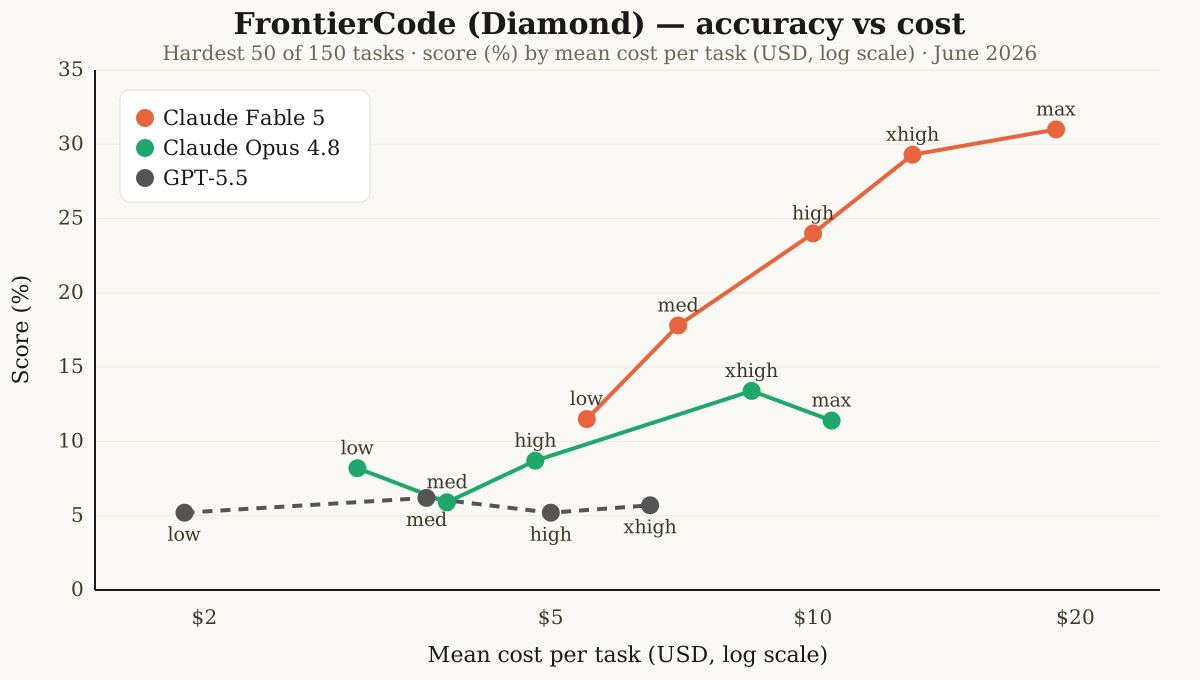
Why this matters to a business reader: for the first time, budget is a capability dial on genuinely hard problems. At roughly the same per-task spend (≈$8–10), Fable 5 at high effort scores around 24% where Opus 4.8 peaks at 13.4%. If a task is worth a senior person’s day, paying $20 of compute for a 31% solve rate on frontier-difficulty work is a trade most CFOs will take. And don’t misread the “low” scores on evaluations like the Legal Agent Benchmark: 13.3% sounds modest until you notice GPT-5.5 scores 2.1% and Gemini 3.1 Pro 0.0% — these are tasks designed to be barely solvable, and Fable 5 is six times further along than the next non-Claude frontier model.
How much does Claude Fable 5 cost — and where do you get it?
Fable 5 is priced at $10 per million input tokens and $50 per million output tokens on the Claude API — roughly double Opus 4.8’s $5 / $25. Anthropic is cushioning the landing for subscribers: Pro, Max, Team and seat-based Enterprise plans include Fable 5 at no extra cost until June 22, 2026, after which usage moves to credit-based billing, with Anthropic stating it intends to fold it back into standard subscriptions as capacity allows. If your team is already rationing Opus usage, our guide to protecting Claude usage limits just became more relevant, not less.
Three access routes matter for companies:
- Claude apps and API. Available immediately as
claude-fable-5for API and consumption-based enterprise customers; in the apps it appears in the model picker once enabled for your workspace, and admins can allow or restrict it per workspace or seat. - GitHub Copilot. Available on Pro+, Max, Business and Enterprise tiers across VS Code, Visual Studio, JetBrains, Xcode, Eclipse, GitHub.com, the Copilot CLI and the cloud agent. Crucially for governance: it’s an admin policy that is off by default, and switching it on is an explicit acknowledgement of Anthropic’s 30-day data-retention requirement. GitHub’s own benchmarks show Fable 5 completing autonomous coding workflows with fewer tool calls and lower token consumption than prior Opus-tier models.
- Google Gemini Enterprise Agent Platform / Vertex AI. Fable 5 ships as a partner model in Model Garden. Enabling it in a GCP project requires consenting to the Advanced AI Safety Addendum, accepting Anthropic’s marketplace terms, enabling the model per region, and turning on prompt-response sharing with Anthropic — then it’s available for agents, computer use, prompt caching, function calling and batch workloads.
The pattern to notice: every enterprise surface gates Fable 5 behind an explicit administrative decision. That’s unusual, and it’s your opening to do the governance work before the model arrives, not after. Our CISO’s guide to enterprise AI security covers the checklist.
What actually changes for day-to-day work
Anthropic’s framing is that Fable 5 can “stay with a problem far longer than any model before it” — operating autonomously for days, coordinating tools, and validating its own work at high reasoning effort. The early-customer evidence says this is not marketing copy.
Software engineering: the migration machine
The headline case study is Stripe, which used Fable 5 to complete a codebase-wide migration across a 50-million-line Ruby codebase in a single day — work that would otherwise have taken a team months. Other early partners report that Fable 5 “one-shots” full applications that previously needed dozens or hundreds of prompts, and anticipates edge cases instead of waiting to be told about them. Combined with the Terminal-Bench (88.0%) and SWE-Bench Pro (80.3%) numbers, the practical translation is: framework upgrades, language migrations and cross-cutting refactors that never made it off the backlog are now projects you can scope in days. For where this sits next to Copilot and plain coding, see when to use Claude, Copilot or code.
Finance, analytics and knowledge work
On Hebbia’s Finance Benchmark for senior-level reasoning, Fable 5 ranks highest among tested models, with the biggest gains in document-based reasoning, chart and table interpretation, and expected-value analysis. Trading firm IMC found it performing at or above their internal senior-analyst benchmarks on factual lookup, conceptual reasoning and root-cause analysis. And analytics platform Hex reports Fable 5 is the first model to clear 90% on its core analytics benchmark of long-running analytical tasks — roughly ten points ahead of Opus 4.8 — while finishing everyday spreadsheet workflows 25–30% faster and in fewer turns. In plain terms: more of your exploratory analysis, reporting and dashboard-building can be delegated to agentic workflows with less babysitting.
Vision: from screenshot to system
Fable 5 extracts precise quantitative data from dense scientific figures and can reconstruct working applications from screenshots alone — capabilities earlier Claude models needed scaffolding and extra tools to approximate. Two office workflows fall out of this immediately: screenshot a legacy dashboard or PDF report and have Fable 5 reverse-engineer the underlying logic into SQL or analytics code; or capture a legacy UI and have it generate a modern front-end and API layer as the start of a modernisation project.
Long-horizon work and memory
With up to 1 million tokens of input, Fable 5 ingests entire repositories or multi-quarter document dumps in one go. More importantly, Anthropic’s experiments show that when paired with persistent file-based memory, Fable 5 tripled its performance over Opus 4.8 on the long-horizon strategy game Slay the Spire, reaching late-game states three times more often — a proxy for the thing businesses actually care about: an agent that accumulates notes, refines hypotheses and keeps multi-day projects coherent instead of starting from zero each session. If your team builds reusable workflows, this is where Claude skills compound.
The trade-offs your rollout has to govern
An honest brief names the costs. Fable 5 has three, and all of them are manageable if you plan for them.
1. Safety fallbacks can interrupt legitimate work
The classifiers that make general availability possible are deliberately conservative. Anthropic acknowledges false positives that can affect legitimate security research and advanced scientific work, particularly in biology and chemistry — when triggered, the request silently downgrades to Opus 4.8 quality (with a notification). Red-team results show the same system blocks meaningful progress on offensive cyber tasks even under common jailbreaks, which is the point. Brief your security and R&D teams that a fallback is expected behaviour, not a bug — and that eligible organisations can apply for Mythos 5 trusted access through Anthropic’s partner programme if their work keeps tripping the filters.
2. The 30-day data-retention requirement
To run those safety systems, Anthropic requires 30-day retention of prompts and outputs for all Mythos-class usage — including Fable 5, on every surface, first- and third-party. The data is used only to defend against complex attacks (such as multi-turn jailbreaks) and to reduce false positives, and is deleted after 30 days in almost all cases — but it is a real departure from the zero-data-retention arrangements many enterprises negotiated for other Claude models. If you operate under strict data-sovereignty or matter-confidentiality rules (legal, health, financial services), classify which workloads can tolerate 30-day retention before enabling the model. Our AI data residency guide for UK enterprises walks through the framework.
3. Twice the token price — but count cost per outcome
At $10 / $50 per million tokens, Fable 5 is the wrong tool for routine summarisation and everyday Q&A — that work belongs on Opus 4.8, Sonnet or Haiku. But early adopters consistently report Fable 5 finishing complex tasks in fewer turns and fewer total tokens, sometimes compressing months of work into days. The metric that matters is cost per completed unit of work, not cost per token: a $40 agent run that replaces a week of senior engineering time is the cheapest labour you will buy this year. The discipline is routing — which is a governance and training problem, the kind we cover in measuring AI training ROI.
Fable 5 or Opus 4.8: which model for which job?
Most companies should run both. Here’s the routing table we’re recommending to clients:
| Workload | Use | Why |
|---|---|---|
| Whole-codebase migrations, multi-day agent runs, frontier-difficulty engineering | Fable 5 | Long-horizon autonomy and the FrontierCode-class gains are the whole point; fewer interventions, fewer total tokens. |
| Senior-level financial analysis, multi-hundred-page document synthesis, complex analytics | Fable 5 | Leads Hebbia, GDPval-AA and Hex benchmarks; vision gains on charts and tables compound the advantage. |
| Contract redlining and legal drafting (with human review) | Fable 5 | Early-access legal partners found its redlines matched or beat their incumbent model in every blind review — but check the 30-day retention against confidentiality rules first. |
| Everyday serious knowledge work: memos, real coding tasks, research, reports | Opus 4.8 | Half the price, zero-data-retention options, and the effort selector covers most depth needs — see our Opus 4.8 guide. |
| Quick answers, routine rewrites, high-volume tasks | Sonnet / Haiku | Frontier capability is wasted here; protect your budget and limits. |
| Offensive security research, advanced bio/chem work | Opus 4.8 or Mythos trusted access | Fable 5’s classifiers will fall back on these anyway; eligible teams should apply for Project Glasswing access. |
For the wider vendor question — Claude vs ChatGPT vs Gemini as a platform decision — our Claude vs ChatGPT for business comparison still holds; Fable 5 simply raises the ceiling on the Claude side.
How to roll out Fable 5 without burning budget (or trust)
The model is the easy part. Here’s the five-step sequence we run with clients:
- Pick two or three high-value, long-horizon workloads — a stalled migration, a recurring senior-analysis bottleneck, a modernisation project. Fable 5 is justified by compressing weeks into days, not by marginally better chat.
- Enable it through a governed surface. Use the Copilot admin policy or workspace-level controls so access maps to the teams that own those workloads. The off-by-default posture is a feature — keep it.
- Clear the retention question first. Classify which data can tolerate 30-day retention; route everything else to Opus 4.8. Write it down — one paragraph in your AI policy beats a quarter of Slack arguments.
- Brief users on the two surprises: safety fallbacks to Opus 4.8 (expected, notified, not a bug) and the temporary inclusion in subscriptions until June 22, 2026 (after which usage is credit-based — budget accordingly).
- Measure cost per outcome from week one. Tokens per completed task, interventions per agent run, calendar time saved. That’s the evidence that survives the CFO conversation.
Why this rarely sticks on its own: across large organisations, roughly 91% have invested in AI tools but only about 21% of employees use them weekly (Deloitte, BCG and McKinsey surveys, 2024–2026). A more autonomous model widens that gap if workflows don’t change — the mechanism is explained in why AI adoption fails in companies.
Two ways to start
1. Run the free AI diagnosis. Eight minutes, five dimensions (strategy, workflows, data, people, governance), and a personalised report telling you whether your organisation is ready to put a Mythos-class model to work — and the two moves we’d make first.
2. Book a free audit call. Thirty minutes, no deck, no pitch. We’ll map where Fable 5 (or a cheaper model) actually pays off in your workflows, and tell you honestly whether you need us.
Run the free AI diagnosis →Where Spicy Advisory fits
We help teams get from “we enabled the new model” to “it changed our throughput”: workload selection, the retention and governance policy, workflow redesign on real deliverables, and the enablement that closes the 91/21 gap. We’re tool-agnostic and work in English or French, in person and hybrid across the UK and EU — see our Claude training for teams, AI training in the UK and Spicy Advisory for Enterprise. Smaller team? The Claude for small business guide is the gentler on-ramp, and our 2026 launches roundup keeps the wider model race in perspective.
Frequently Asked Questions
What is Claude Fable 5?
Claude Fable 5 is Anthropic’s most capable generally available model, released in June 2026 as the first model of the new Mythos class — a capability tier above Opus. It shares the same underlying model as the restricted Claude Mythos 5 but adds safety classifiers that route high-risk cybersecurity, biology/chemistry and model-distillation requests to Claude Opus 4.8. It supports text, image and PDF inputs, a 1M-token context window and 128k output tokens, and is built for long-horizon autonomous work: multi-day projects, whole-codebase migrations and complex analysis.
How is Claude Fable 5 different from Claude Mythos 5?
They are the same underlying model. Claude Mythos 5 is available only to vetted cyber-defence and scientific partners through Anthropic’s Project Glasswing trusted-access programme, without the restrictive classifiers. Claude Fable 5 is the generally available version: identical capability, plus safety classifiers that detect high-risk content and fall back to Claude Opus 4.8 when triggered. Anthropic reports benchmark scores within 1–3 percentage points between the two, except on cybersecurity- and biology-adjacent evaluations where Fable 5’s fallbacks pull it closer to Opus 4.8.
How much does Claude Fable 5 cost?
On the Claude API, Fable 5 costs $10 per million input tokens and $50 per million output tokens — roughly double Claude Opus 4.8’s $5 / $25. It is temporarily included at no extra cost in Claude Pro, Max, Team and seat-based Enterprise plans until June 22, 2026, after which usage moves to credit-based billing. Because it typically completes complex tasks in fewer turns and fewer total tokens, the per-task cost gap versus Opus 4.8 is often smaller than the per-token pricing suggests.
Is Claude Fable 5 better than Claude Opus 4.8?
On capability, yes — substantially, on hard tasks: 80.3% vs 69.2% on SWE-Bench Pro, 29.3% vs 13.4% on FrontierCode Diamond, and about ten points ahead on Hex’s analytics benchmark. But Opus 4.8 remains the better default for everyday knowledge work: it costs half as much, supports zero-data-retention arrangements, and its effort selector covers most depth needs. The right pattern for most companies is both: Fable 5 for long-horizon, high-value work; Opus 4.8 (with Sonnet and Haiku below it) for everything else.
Why does Claude Fable 5 require 30-day data retention?
Anthropic requires 30-day retention of prompts and outputs for all Mythos-class models, including Fable 5, on first- and third-party surfaces, to operate its safety systems — defending against complex multi-turn jailbreaks and reducing classifier false positives. The data is deleted after 30 days in almost all cases. This differs from the zero-data-retention policies available on other Claude models, so companies in regulated sectors should classify which workloads can tolerate it before enabling Fable 5; on GitHub Copilot, admins must explicitly acknowledge the requirement to switch the model on.
How do I enable Claude Fable 5 in GitHub Copilot or Google Vertex AI?
In GitHub Copilot (Pro+, Max, Business and Enterprise tiers), an administrator must enable the “Claude Fable 5” policy — it is off by default, and enabling it acknowledges Anthropic’s 30-day data retention. On Google’s Gemini Enterprise Agent Platform, Fable 5 is a partner model in Vertex AI Model Garden: you consent to the Advanced AI Safety Addendum, accept Anthropic’s marketplace terms in Google Cloud Marketplace, enable the model in your chosen regions, and turn on prompt-response sharing with Anthropic. In Claude itself, admins can allow or restrict Fable 5 per workspace or seat.
What happens when Fable 5’s safety classifiers trigger?
When Fable 5 detects a high-risk request — offensive cybersecurity, certain biology and chemistry topics, or model distillation — it does not answer directly. The request is routed to Claude Opus 4.8 and the user is notified of the fallback. The classifiers are deliberately conservative, so false positives can affect legitimate security research or advanced scientific work; teams whose work repeatedly trips the filters can apply for Claude Mythos 5 trusted access through Anthropic’s partner programme.
Sources & further reading: Anthropic, Introducing Claude Fable 5 and Claude Mythos 5 (anthropic.com/news/claude-fable-5-mythos-5) — benchmark table and FrontierCode accuracy-vs-cost data, June 2026; partner results reported at launch: Stripe (50M-line codebase migration), Hebbia Finance Benchmark, IMC, Hex analytics benchmark, Genspark/ViBench, GitHub Copilot internal benchmarks, Google Vertex AI Model Garden documentation; video overview: Claude Fable 5 explained (YouTube); enterprise AI adoption gap from Deloitte, BCG and McKinsey surveys (2024–2026). Internal references: Claude Opus 4.8 business guide, Claude for companies, Claude getting-started for teams, Claude vs ChatGPT for business, when to use Claude, Copilot or code, protecting Claude usage limits, AI agents for enterprise workflows, 50 Claude skills, AI data residency, CISO guide to enterprise AI security, why AI adoption fails, measuring AI training ROI, Claude for small business, 2026 model announcements for companies, free AI diagnosis, book an audit call.