AI ROI CALCULATOR
FOR UK TEAMS
How many hours — and how much money — would your team actually get back from AI? Built on published UK data, not vendor hype.
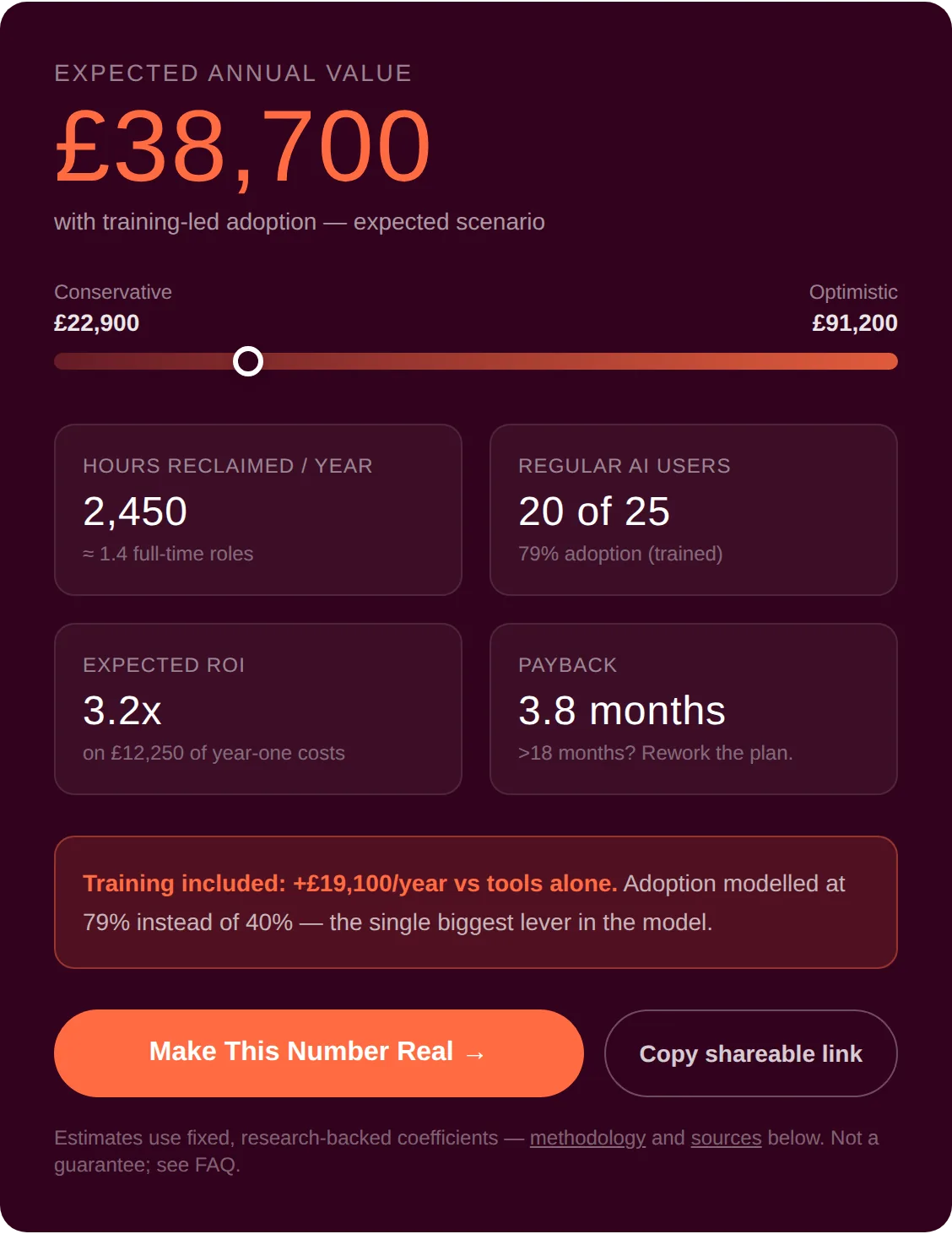
The Spicy Advisory AI ROI Calculator estimates the annual return of AI adoption for UK teams. It combines ONS salary and working-hours data, HMRC employer costs (National Insurance, pension) and measured productivity research — the Federal Reserve Bank of St. Louis, Google's UK AI Works pilots, BCG's AI at Work study — into a conservative-to-optimistic value range, never a single inflated number. For a typical 25-person UK team on median salaries, expected value is roughly £19,600–£38,700 a year depending on whether adoption is trained or left to chance. Free, instant, no email gate.
YOUR TEAM
Five inputs. Every other assumption is fixed to published research — see exactly how it works.
People whose day-to-day work involves writing, analysis, admin, reporting or communication.
Default is the UK full-time median, £39,039 (ONS, April 2025). Or pick a role:
Sets the share of your team we count as regular AI users — from 20% to 55% without training (St. Louis Fed; BCG).
Advanced: adjust costs
Defaults: £20/seat/month ≈ ChatGPT Team / Microsoft Copilot business tiers; £250/person ≈ a half-day group workshop, pro-rated.
Expected annual value
£19,600
if your team adopts AI without structured training
Hours reclaimed / year
1,240
≈ 0.7 full-time roles
Regular AI users
10 of 25
40% adoption
Expected ROI
3.3x
on £6,000/yr of costs
Payback
3.7 months
>18 months? Rework the plan.
+£19,100/year with structured training. Training roughly doubles adoption (40% → 79% of your team as regular users) — flip the toggle to see it in your numbers.
Estimates use fixed, research-backed coefficients — methodology and sources below. Not a guarantee; see FAQ.
HOW THE CALCULATOR WORKS
Most AI ROI calculators let you type in your own "hours saved", multiply by 52 weeks and assume everyone adopts. Ours doesn't. Every coefficient below is fixed to a published source, and the three scenarios run in parallel — you always see a range, never one flattering number.
1. Fully-loaded hourly cost — derived, not asserted
hourly cost = (salary × 1.25) ÷ 1,700 hours
UK employees cost more than their salary: employer National Insurance is 15% above £5,000 (2025/26) and auto-enrolment pension adds a minimum 3% — roughly 16% of extra mandatory cost at the median wage, before equipment and overheads. We use a conservative 1.25x multiplier from the published 1.25–1.4x "true cost of employment" range. The 1,700 annual hours come from ONS actual working hours (36.7/week) across ~46.4 working weeks after statutory holiday. A £39,000 salary works out at £28.68 per working hour.
2. Adoption — because not everyone will use it
regular users = team × adoption rate (20–55% by current usage; ×2 with training, capped at 79%)
Around 37% of working-age adults use generative AI at work (St. Louis Fed, 2025) and BCG found frontline regular use stalls around 51%. So without training we count 20–55% of your team as regular users, depending on where you are today. Google's UK AI Works pilots found a few hours of training roughly doubled sustained adoption, and BCG measured 79% regular use among employees with 5+ hours of training — that 79% is our hard cap. We never model 100% adoption.
3. Hours saved — fixed to research, not your imagination
hours reclaimed = regular users × (2.2 | 2.7 | 5.0 hrs/week) × 46 weeks
This is the number every other calculator lets you guess. We fix it: 2.2 hrs/week (conservative) is the St. Louis Fed's measured 5.4% of work hours saved by generative AI users; 2.7 hrs/week (expected) is Google's UK AI Works finding of 122 hours a year; 5.0 hrs/week (optimistic) is what professionals told Thomson Reuters they expect AI to save by 2026 — a prediction, so it's labelled optimistic. And we use 46 working weeks, not 52: UK statutory holiday is 5.6 weeks, and calculators that multiply by 52 inflate results by ~13%.
4. Value conversion — saved time isn't automatically money
gross value = hours reclaimed × (40% | 55% | 70%) × hourly cost
The most honest step, and the one competitors skip. A national study of 25,000 Danish workers (Humlum & Vestergaard) found AI time savings produced almost no measurable wage or output change where organisations didn't deliberately capture the time. Adecco's survey of 35,000 workers found ~79% do reinvest saved time into work. We count 40–70% of reclaimed hours as realised value — never 100%.
5. Costs, ROI and payback — because tools and training aren't free
ROI = gross value ÷ (tools £/seat × 12 × team + training £/person × team)
We subtract what you'd actually spend: business-tier AI seats (default £20/seat/month) and one-off structured training (default £250/person, editable). Payback is the months of value needed to cover year-one costs. Our rule of thumb, borrowed from the more honest end of the industry: if payback exceeds 18 months, rework the plan before rolling out.
What we deliberately don't do
- ❌ No editable "hours saved" field — that's where wishful thinking enters every other calculator.
- ❌ No 100% adoption — the measured ceiling for trained teams is 79% (BCG).
- ❌ No 52-week years — UK statutory holiday exists.
- ❌ No single point estimate — you get conservative, expected and optimistic, always.
- ❌ No email gate — results are on screen, and the shareable link is free.
Known simplifications: the 1.25x on-cost is flat (small employers with Employment Allowance pay slightly less NI); results are annualised steady-state rather than ramped month-by-month; role presets change salary, not hours saved. Role-level research (customer support +15% productivity, writing tasks 40% faster, developers up to 55% faster) is cited in the data table but kept out of the arithmetic to keep the model auditable.
WHAT UK TEAMS CAN EXPECT FROM AI ADOPTION
Pre-computed results at the calculator's defaults — UK median salary (£39,000), team already experimenting with AI, structured training included, business-tier tools at £20/seat/month, training at £250/person. Value is the realised annual £ band after adoption, value-conversion and UK working-week adjustments.
| Team size | Hours reclaimed / year (expected) | Conservative | Expected value | Optimistic | Year-one costs | Expected ROI |
|---|---|---|---|---|---|---|
| 10 people | ~980 hrs | £9,200 | £15,500 | £36,500 | £4,900 | 3.2x |
| 25 people | ~2,450 hrs | £22,900 | £38,700 | £91,200 | £12,250 | 3.2x |
| 50 people | ~4,900 hrs | £45,900 | £77,400 | £182,400 | £24,500 | 3.2x |
| 100 people | ~9,800 hrs | £91,700 | £154,800 | £364,700 | £49,000 | 3.2x |
Without structured training the same teams land at roughly half the value — a 25-person team drops from an expected £38,700 to £19,600 a year, because adoption stalls at ~40% instead of 79%. That gap, not the tools, is where most UK AI ROI is won or lost.
THE DATA BEHIND THIS CALCULATOR
Every number in the model traces to one of these published sources. No "our client benchmarks", no vendor decks presented as science.
| Statistic | Figure | Source | Date |
|---|---|---|---|
| UK full-time median gross annual salary | £39,039 | ONS, Annual Survey of Hours and Earnings | Apr 2025 |
| Employer National Insurance rate | 15% above £5,000 | HMRC, rates and thresholds for employers 2025/26 | 2025/26 |
| Minimum employer pension contribution | 3% of qualifying earnings | GOV.UK, workplace pensions | 2025/26 |
| UK statutory paid holiday | 5.6 weeks/year | GOV.UK, holiday entitlement | Current |
| Time saved by generative AI users (measured) | 5.4% of work hours ≈ 2.2 hrs/week | Federal Reserve Bank of St. Louis (Bick, Blandin & Deming) | Feb 2025 |
| UK workers' time saved with AI + training | 122 hours/year ≈ 2.7 hrs/week | Google / Public First, AI Works UK pilots | 2025 |
| Professionals' predicted AI time saving | 5 hrs/week | Thomson Reuters, Future of Professionals | 2025 |
| Regular AI use with 5+ hours of training | 79% of employees | BCG, AI at Work 2025 (10,635 employees) | Jun 2025 |
| Organisations reporting significant AI ROI, with vs without mature upskilling | 42% vs 21% | DataCamp / YouGov, State of Data & AI Literacy | 2026 |
| Workers reinvesting AI-saved time into work | ~79% | The Adecco Group, Global Workforce of the Future (35,000 workers) | Oct 2024 |
| AI time savings without organisational capture | ~3% of hours; near-zero earnings impact | Humlum & Vestergaard, NBER (25,000 Danish workers) | Apr 2025 |
| Enterprise GenAI pilots with no measurable P&L return | 95% | MIT NANDA, The GenAI Divide: State of AI in Business | Jul 2025 |
| Writing tasks completed faster with AI (RCT) | 40% faster, 18% higher quality | Noy & Zhang, Science | Jul 2023 |
| UK businesses using AI | 29% (49% of firms with 250+ staff) | ONS, Business Insights and Conditions Survey | Jun 2026 |
WHY MOST AI ROI NEVER SHOWS UP
The calculator shows what's available. The research is blunt about why most companies don't collect it.
95%
of enterprise GenAI pilots show no measurable P&L impact — the barrier is missing training, workflow integration and measurement, not the technology (MIT, 2025).
~40%
is where team adoption stalls when tools are bought but nobody is trained — licences alone don't change how people work (St. Louis Fed; BCG).
2x
structured training roughly doubles sustained adoption (Google AI Works, UK) — and doubles the share of organisations reporting significant ROI (DataCamp/YouGov, 2026).
That's the entire Spicy Advisory thesis in three numbers: the gap between AI's potential and most companies' results is an execution gap — and it closes with workflow-first training, a right-sized usage policy, and adoption someone actually owns. It's what we do for UK teams from London to Edinburgh, starting at £3,500.
Book a Free 20-Minute CallFREQUENTLY ASKED QUESTIONS
Straight answers about the model, the maths and what the output actually means.
How does this AI ROI calculator estimate hours saved?
We fix hours saved to published research rather than letting you type a guess. The conservative figure (2.2 hours per week per AI user) comes from the Federal Reserve Bank of St. Louis's measured survey of workers; the expected figure (2.7 hours per week) from Google's UK AI Works pilots (122 hours per year); the optimistic figure (5 hours per week) from Thomson Reuters' 2025 Future of Professionals survey — which is a prediction, so we label it optimistic.
Why does the calculator show a range instead of one number?
Because a single ROI figure is false precision. Measured AI savings vary from roughly 3% of work hours (a Danish national study of 25,000 workers) to 5+ hours a week (professional-services surveys), and outcomes depend heavily on adoption and implementation. We show conservative, expected and optimistic scenarios so you can plan against the low end and aim for the high end.
Why doesn't the calculator assume everyone on my team will use AI?
Because they won't. Around 37% of working-age adults use generative AI at work (St. Louis Fed, 2025), and BCG found frontline regular use stalls around 51%. Even with 5+ hours of structured training, regular use reaches about 79% — which is the cap we apply. Calculators that assume 100% adoption overstate value roughly 2x.
What difference does AI training actually make to ROI?
Two well-evidenced effects: Google's UK AI Works pilots found a few hours of training roughly doubled sustained adoption, and a 2026 DataCamp/YouGov survey found organisations with mature AI upskilling were twice as likely (42% vs 21%) to report significant ROI from AI. We model training as doubling your team's adoption rate, capped at 79% (BCG's measured ceiling for trained employees).
Why is the cost per hour higher than the salary suggests?
UK employees cost more than their salary: employer National Insurance (15% above £5,000 from April 2025) and the 3% minimum auto-enrolment pension add roughly 16% at the median wage, before equipment and overheads. We use a conservative 1.25x fully-loaded multiplier, so a £39,000 salary is about £28.70 per working hour across roughly 1,700 actual annual working hours.
Does time saved by AI automatically become financial value?
No — that is the biggest honest caveat in the research. A study of 25,000 Danish workers found AI time savings produced almost no wage or output change where organisations didn't deliberately capture the time, while Adecco found around 79% of workers do reinvest saved time into work. We therefore count only 40–70% of saved hours as realised value, never 100%.
What is a good ROI for AI adoption in 2026?
For a typical UK team paying for business-tier AI tools and structured training, our model puts expected ROI around 3x with payback inside 4–6 months. IDC (in a Microsoft-sponsored study) reports organisations averaging $3.7 of return per $1 invested in generative AI. A useful rule of thumb: if your projected payback is longer than 18 months, rework the plan before rolling out.
Is this calculator's estimate guaranteed?
No. MIT research found 95% of enterprise AI pilots showed no measurable P&L impact — mostly due to missing training, workflow integration and measurement, not the technology. Treat the output as the value available if you execute adoption well; the gap between the "without training" and "with training" scenarios is precisely the execution gap.
TURN THE ESTIMATE INTO A NUMBER YOU CAN DEFEND
Book a free 20-minute call. We'll pressure-test your inputs, tell you honestly where AI pays back first in your business — and where it won't.
Book Your Free AI Audit